
Stocks vs Options: Which Makes You More Money in 2026? (India, US & Global Guide)
💡 Quick Answer: Stocks give you ownership and long-term stability. Options give you leverage and the ability to profit faster — but with higher risk. For Indian intraday traders in 2026, both have changed significantly due to new SEBI rules and Budget 2026 STT hikes. Read on to find out which one suits YOUR goal.
Table of Contents
What Are Stocks?
What Are Options?
Key Differences Between Stocks and Options
Real Profit Examples — India (NSE/BSE) and US (NYSE/NASDAQ)
Risk Comparison: Which Is Safer?
SEBI's New F&O Rules in 2026 — What Every Indian Trader Must Know
STT and Tax Charges on Stocks and Options in India (Budget 2026 Update)
Options vs Stocks for Different Trader Types
Stocks vs Options: US, UK, Canada, Australia and Global Perspective
Common Mistakes Beginners Make
Which Should YOU Choose in 2026?
FAQs
Final Verdict
1. What Are Stocks?
When you buy a stock — also called a share or equity — you are buying a small piece of ownership in a company.
If you buy shares of Reliance Industries on NSE or Apple Inc. on NASDAQ, you become a part-owner of that business. When the company grows, your share value rises. When the company earns profits, you may receive dividends.
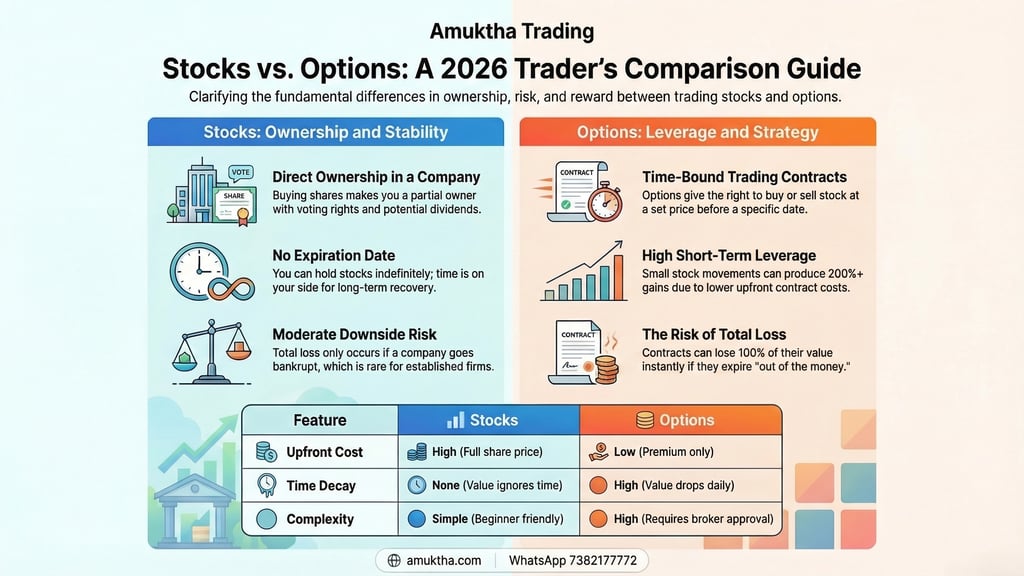
Stocks have no expiry date, which means you can hold them for days, months, or decades. Their price moves with the performance of the underlying business. They require the full purchase price of the shares as capital, offer lower leverage than options, but also carry a much lower risk of total loss. They are suitable for both short-term intraday trading and long-term wealth building.
If you are in India, you are likely familiar with stocks like TCS, Infosys, HDFC Bank, Reliance, and Zomato — all traded on NSE and BSE. Globally, the most recognisable stock names include Apple, Tesla, Microsoft, and Amazon, traded on the NYSE and NASDAQ.
2. What Are Options?
An option is a contract that gives you the right — but not the obligation — to buy or sell a stock or index at a specific price before a specific date.
Think of it like a booking fee. You pay a small premium upfront to lock in a price. If the market moves your way, you profit significantly. If it moves against you, you lose only the premium you paid — nothing more (for buyers).
There are two types of options. A Call Option gives you the right to buy at a set price, and you use it when you expect the price to go up. A Put Option gives you the right to sell at a set price, and you use it when you expect the price to go down.
In India, options are traded on NSE and BSE on indices like Nifty 50, Bank Nifty, and Sensex, as well as on individual F&O stocks. In the US, options are traded on the Chicago Board Options Exchange (CBOE) on stocks and ETFs like SPY, QQQ, and AAPL.
3. Key Differences Between Stocks and Options
When you buy a stock, you own a share of the company. When you buy an option, you own a contract — the right to buy or sell, but not actual ownership. Stocks have no expiry date, so you can hold them indefinitely. Options have a fixed expiry date — weekly or monthly — and their value decreases as that date approaches.
Stocks require the full share price as capital. Options require only the premium, which is a fraction of the stock price, making them accessible with much smaller capital. However, this leverage cuts both ways. The leverage in options can be anywhere from 5x to 50x or more, whereas stocks are essentially 1:1.
For stock buyers, the maximum loss is the total amount invested if the company goes bankrupt — rare in blue-chip stocks. For option buyers, the maximum loss is only the premium paid. For option sellers, however, losses can theoretically be unlimited if the market moves sharply against them.
In terms of complexity, stocks are straightforward and beginner-friendly. Options are medium to high in complexity and best suited for traders who have already spent time understanding the stock market. Both stock and option trading hours in India run from 9:15 AM to 3:30 PM on NSE and BSE. In the US, both trade from 9:30 AM to 4:00 PM ET.
4. Real Profit Examples — India and Global
India Example: Nifty Options vs Nifty Stocks in 2026
Imagine Nifty 50 is at 24,000 and you expect it to rise by 200 points.
If you take the stock route and invest ₹2,40,000 to replicate the Nifty index through an ETF, a 200-point rise (0.83% move) gives you a profit of approximately ₹2,000 — a 0.83% return on your capital.
If you take the options route and buy one lot of the Nifty 24,000 Call Option at a premium of ₹120, you only need ₹7,800 (₹120 × 65 units per lot, as revised by NSE in January 2026). If Nifty rises 200 points and the premium climbs to ₹280, your profit is (₹280 minus ₹120) multiplied by 65 = ₹10,400. That is a 133% return on ₹7,800.
The power of leverage is obvious. But here is the catch — if Nifty falls instead, the entire ₹7,800 premium can go to zero. Your stock investment would also fall, but you would still own the asset and could recover when markets bounce back.
US Example: Apple Stock vs Apple Options
Say Apple (AAPL) is trading at $200 and you expect it to rise to $210 before expiry.
If you buy 100 shares of AAPL, you invest $20,000. When the price rises to $210, you make a $1,000 profit — a 5% return.
If instead you buy one AAPL $200 Call Option at a $3 premium, you invest just $300 (one US contract covers 100 shares). If Apple rises to $210 and the option premium climbs to $12, your profit is ($12 minus $3) × 100 = $900. That is a 300% return on $300.
Again — if Apple drops, your $300 is at risk. But your $20,000 stock position still holds most of its value.
5. Risk Comparison: Which Is Safer?
Stocks carry a moderate risk profile. The maximum loss is the full amount you invested, but this only happens if the company collapses entirely — which is rare for established blue-chip companies. There is no time pressure. You can hold through market downturns and wait for recovery. Many quality stocks also pay dividends, providing income even in falling markets.
Options have a more complex risk profile that depends on whether you are buying or selling them.
For option buyers, the maximum loss is limited to the premium paid. That sounds safe, but over 70 to 80% of options expire worthless. Every day that passes, the option loses a little more value due to time decay — a concept called Theta. This erosion works silently against you even if the market stays flat.
For option sellers — which is a more advanced strategy — you collect the premium upfront. This sounds attractive, but if the market moves sharply against your position, losses can be theoretically unlimited. In India, SEBI now mandates that brokers collect the full SPAN plus Exposure margin upfront at all times, which means you need significant capital to sell options.
The short version: stocks suit all levels of traders. Buying options suits intermediate traders who understand the market well. Selling options is for advanced, well-capitalised traders only.
6. SEBI's New F&O Rules in 2026 — What Every Indian Trader Must Know
The Securities and Exchange Board of India (SEBI) has made sweeping changes to the F&O trading framework across 2024, 2025, and 2026. If you trade options in India without knowing these rules, you are putting your capital at serious risk.
Rule 1 — Weekly Options Now Limited to One Index Per Exchange
Previously, NSE offered weekly options on Nifty 50, Bank Nifty, FinNifty, and more. Following SEBI's directive, only one benchmark index per exchange is now allowed for weekly expiry. On NSE, only Nifty 50 weekly options remain. On BSE, only Sensex weekly options continue. Bank Nifty and FinNifty weekly options have been discontinued.
For Bank Nifty weekly traders, this was the most disruptive change. These traders must now either shift to Nifty weekly options, trade Bank Nifty monthly contracts (which have different strategy dynamics due to less time decay pressure), or move to individual bank stock options for sector-specific views.
Rule 2 — Lot Sizes Revised in January 2026
NSE revised lot sizes effective January 6, 2026 for weekly expiry contracts and January 27, 2026 for monthly contracts. The Nifty 50 lot size is now 65 units, meaning each one-point move in Nifty generates ₹65 profit or loss per lot. Bank Nifty is now 30 units per lot, and BSE Sensex is 20 units per lot. The revised lot sizes were designed to keep contract values within the SEBI-mandated ₹10 to ₹15 lakh notional value band.
Rule 3 — 100% Upfront Margin Required at All Times
SEBI's peak margin rules, which were phased in from 2020 and fully tightened by 2026, require brokers to collect full SPAN plus Exposure margin throughout the trading day — not just at end of day. SEBI's clearing corporations take four random snapshots during market hours, and brokers face penalties if margin is short at any snapshot. This means you must have the complete margin ready before placing any F&O trade.
Rule 4 — Enhanced KYC for F&O Participation
Traders seeking access to larger F&O positions must now disclose income levels as part of enhanced Know Your Customer requirements. SEBI introduced this to ensure retail participants are financially capable of handling the risk they are taking on.
Rule 5 — Physical Delivery on Stock Options
This is critical for beginners. Index options — Nifty, Bank Nifty, Sensex — are cash-settled, meaning there is no physical share delivery and settlement is straightforward. But stock options on individual companies are a different story. If your stock option is In-The-Money (ITM) at expiry, it is automatically exercised. You must either deliver the shares (for call sellers) or pay the full strike value to take delivery (for put sellers). Retail traders who are unaware of this often face auction penalties.
Recommendation for Indian beginners: Stick to index options — Nifty and Sensex — until you fully understand physical delivery rules. They are simpler, more liquid, and safer from a settlement perspective.
7. STT and Tax Charges on Stocks and Options in India (Budget 2026 Update)
Budget 2026, presented by Finance Minister Nirmala Sitharaman on February 1, 2026, introduced significant hikes in Securities Transaction Tax (STT) on F&O trading — making options and futures meaningfully more expensive than before.
STT is a tax charged on every transaction, regardless of whether you make a profit or a loss. It is deducted automatically by your broker at the time of the trade.
Updated STT Rates Effective April 1, 2026
For equity delivery (buying and selling actual shares), the STT remains 0.1% on both buy and sell sides — unchanged. For intraday equity trades, the rate stays at 0.025% on the sell side only — also unchanged.
For derivatives, the changes are significant. Futures STT on the sell side has been hiked to 0.05%, up from 0.02% — a 150% increase. Options STT on the premium at the time of selling has been hiked to 0.15%, up from 0.1%. The STT on the exercise of options has also increased to 0.15%.
Real Impact on a Trader
Consider a trader executing 10 futures contracts per day, with each contract worth ₹20 lakh. Under the old STT rate of 0.02%, the daily STT was ₹4,000. Under the new rate of 0.05%, it is now ₹10,000 per day — an extra ₹6,000 daily. Over 20 trading days in a month, that is ₹1.2 lakh in additional STT alone, before accounting for brokerage, GST, or exchange charges.
For options traders making multiple small trades per day, the higher 0.15% rate on premiums significantly raises the break-even point. Traders who were marginally profitable before April 2026 may find themselves losing money purely due to increased transaction costs.
Capital Gains Tax in India (2026)
Short-term capital gains (STCG) on equity — stocks held less than one year — are taxed at 20%. Long-term capital gains (LTCG) on equity held for more than one year are taxed at 12.5% on gains above the ₹1.25 lakh annual exemption. F&O trading income, including options, is treated as business income and taxed at your applicable income tax slab rate — which can go up to 30% for higher earners. The silver lining is that F&O traders can deduct trading expenses such as brokerage, internet costs, and software subscriptions from their business income.
Tax Treatment for Global Traders
In the United States, options profits are taxed as short-term capital gains if held less than one year, at ordinary income rates of up to 37%. However, certain index options classified as Section 1256 contracts (such as SPX options) benefit from a special 60/40 rule — 60% of gains are treated as long-term and 40% as short-term, regardless of how long the position was held.
In the United Kingdom, options gains are taxed under Capital Gains Tax rules. The annual CGT exemption is £3,000 in 2026, and standard rates apply above that. Spread betting on indices, however, remains tax-free in the UK — no CGT, no stamp duty — making it a popular alternative for many UK traders.
In Australia, options are treated as capital assets. If held for more than 12 months, traders may qualify for a 50% CGT discount. In Canada, 50% of capital gains are included in taxable income, and registered accounts like TFSA and RRSP allow covered calls but not naked options strategies.
8. Options vs Stocks for Different Trader Types
You should trade stocks if you are a complete beginner with less than one year of market experience. Stocks are also ideal if your goal is long-term wealth building over five to twenty years, if you cannot monitor markets actively during trading hours, if you have less than ₹50,000 (or $1,000 USD) to start, or if you simply want to invest without the stress of daily expiry cycles. For passive investors seeking dividend income, quality blue-chip stocks in India — like HDFC Bank, ITC, Coal India — and dividend ETFs in the US are the natural choice.
You should consider trading options if you have at least six to twelve months of stock market experience, if you can actively monitor your trades during market hours, if you understand concepts like strike price, premium, expiry, and the difference between ITM, OTM, and ATM options. Options also make sense if you want to leverage a smaller capital base into larger positions, or if you want to hedge an existing stock portfolio against downside risk. In India, aim for a minimum capital of ₹1 to 2 lakh for sustainable index options trading under the 2026 SEBI framework. In the US, most brokers recommend at least $2,000 to $5,000 to start.
You should avoid options entirely if you approach trading as gambling, if you are buying cheap out-of-the-money options hoping for a miracle move, if you are holding positions overnight without understanding gap risk, if you are using borrowed money, or if you have not spent time learning and paper trading first.
9. Stocks vs Options: US, UK, Canada, Australia and Global Perspective
United States
The US options market is the most liquid in the world. The CBOE handles trillions of dollars in options volume every single day. US brokers like TD Ameritrade, Charles Schwab, and Robinhood require traders to apply for options access, with approval levels ranging from Level 1 (covered calls only) to Level 4 (naked puts and advanced spreads), based on experience and financial background.
Weekly options are available on most major US stocks and ETFs, and SPY, QQQ, and AAPL options are among the most actively traded in the world. US traders should also be aware of the Pattern Day Trader (PDT) rule — if you make four or more day trades within five business days with under $25,000 in your account, your broker is required to flag your account and restrict further day trading.
United Kingdom
UK traders typically access options through spread betting or CFD platforms such as IG Markets and CMC Markets, or directly through brokers like Interactive Brokers. ISA accounts in the UK do not permit options trading, so you must use a standard brokerage account. Spread betting on indices deserves special mention — it is entirely tax-free in the UK, with no Capital Gains Tax and no stamp duty, making it a very efficient way for UK residents to trade index movements.
Canada
Canadian traders can access options on the Toronto Stock Exchange (TSX) as well as US markets through most brokers. Registered accounts like TFSA and RRSP do allow options trading, but only conservative strategies like covered calls — not naked options. Options profits are treated as capital gains, with 50% of the gain included in taxable income.
Australia
Options are traded on the Australian Securities Exchange (ASX), with retail options available for major ASX-listed companies. The Australian Securities and Investments Commission (ASIC) regulates derivatives and applies leverage limits to retail traders — similar in spirit to the ESMA rules in Europe. If you hold an option position for more than twelve months in Australia, you may qualify for the 50% CGT discount.
Europe
Across Europe, the European Securities and Markets Authority (ESMA) sets strict limits on CFD and derivatives leverage for retail traders to protect them from excessive risk. Options are available on major European exchanges including Euronext and Deutsche Börse's EUREX platform. Popular platforms used by European traders include Interactive Brokers, Saxo Bank, and Degiro.
10. Common Mistakes Beginners Make
Whether you are in Hyderabad, Mumbai, New York, or London, the same mistakes destroy beginner traders' accounts across the world every year.
The most common is buying cheap out-of-the-money (OTM) options hoping they will suddenly become profitable. A ₹10 or $0.10 option is cheap precisely because the market believes it has very little chance of making money. Most of these expire completely worthless.
Ignoring time decay is equally damaging. Options lose value every single day — even when the underlying stock or index does not move at all. On expiry day, an OTM option can drop from ₹50 to zero within hours, even if the market only moves slightly against you.
Over-leveraging is another major trap. Trading one lot feels manageable. But traders who scale up to ten or twenty lots of the same position expose themselves to account-wiping losses on a single gap-down open. Position sizing discipline is what separates surviving traders from those who quit.
Not using stop-losses is the most expensive habit of all. "It will come back" is perhaps the most costly phrase in trading. Markets can and do move far further and faster than most beginners expect.
For Indian traders specifically, holding stock options to expiry without understanding physical delivery is a serious mistake. If your stock option is ITM at expiry, you will be required to deliver or receive the underlying shares. Failing to do so results in auction penalties that can significantly exceed your original trade size.
The new STT costs from Budget 2026 are also being ignored by many active traders. With options STT now at 0.15% on the sell side, traders who make many small trades throughout the day are now paying meaningfully more per transaction. Your profit target needs to be recalibrated to account for these higher costs.
Finally, SEBI data shows that over 93% of F&O traders in India lose money. Options trading is not a side income or a quick wealth strategy. It requires skill, discipline, continuous learning, and solid risk management.
11. Which Should YOU Choose in 2026?
If you are a complete beginner making your first investment, start with stocks or index ETFs — no question. If your goal is building long-term wealth over five to twenty years, stocks and mutual funds are your foundation. If you are an experienced intraday trader who understands market dynamics, index options (Nifty on NSE, Sensex on BSE) offer powerful leverage opportunities, but only with proper capital and risk management.
If you have less than ₹50,000 in India, stay in stocks. With ₹1 to 5 lakh, you can explore a combination of stocks with selective Nifty options. Above ₹5 lakh and with genuine experience, you can build active options strategies while keeping stocks as your portfolio anchor.
In the US, if you have less than $25,000, stock investing with occasional long-dated options is a smart combination. Above $25,000 with experience, covered calls, protective puts, and defined-risk spreads are excellent tools to enhance returns.
If you are a passive income seeker, dividend-paying stocks and covered calls on stocks you already own are the most reliable combination — generating regular income without requiring you to time the market every week.
12. FAQs
Can I trade options without knowing stocks first?
No. Options derive their entire value from the underlying stock or index. Without understanding how the underlying market moves, you cannot make sense of why an option premium rises or falls. Always learn stocks first, then layer options knowledge on top.
What is the minimum capital to start options trading in India in 2026?
For index options (Nifty), you need at least ₹6,000 to ₹15,000 to buy one lot's worth of premium. However, to trade sustainably, manage risk properly, and handle multiple trades without blowing your account on one bad day, start with a minimum of ₹1 to 2 lakh.
Are options better than stocks for intraday trading in India?
Options offer significantly higher leverage for intraday moves. A 50-point Nifty move can produce returns of 30 to 100% or more on an options position. But after the SEBI 2026 rule changes, the removal of Bank Nifty weekly options, and the Budget 2026 STT hikes, the cost and complexity of options trading have both increased. Many intraday traders who were profitable in 2023 and 2024 are finding it harder to maintain the same results in 2026. Stocks may offer better risk-adjusted returns for some intraday traders now.
What happened to Bank Nifty weekly options?
SEBI discontinued Bank Nifty weekly options as part of its broader effort to curb speculative excess in the derivatives market. Only Nifty 50 weekly options continue on NSE. Bank Nifty monthly options still exist and remain fully tradeable.
Is options trading taxed differently from stock trading in India?
Yes, significantly so. Gains from stock investing are taxed as Short-Term Capital Gains (STCG) at 20% if held less than one year, or Long-Term Capital Gains (LTCG) at 12.5% if held over one year. F&O trading — including all options trades — is classified as business income and taxed at your income tax slab rate, which can go up to 30% for higher earners. The positive side is that F&O traders can deduct legitimate trading expenses from their business income.
Can NRIs trade options in India?
NRIs can invest in Indian equities (delivery-based stock purchases) through NRE or NRO accounts. However, F&O trading — including options — is currently not permitted for NRIs on Indian exchanges under FEMA regulations. NRIs can freely trade options on US markets through brokers like Interactive Brokers or Schwab International.
How are options taxed in the United States?
Options held for less than one year are taxed as short-term capital gains at ordinary income rates, which can reach up to 37% for high earners. An important exception applies to broad-based index options classified as Section 1256 contracts — these include SPX, NDX, and RUT options. Gains and losses on these are subject to the 60/40 rule: 60% of gains are taxed at the lower long-term capital gains rate and 40% at the short-term rate, regardless of how long you held the position.
13. Final Verdict
Stocks are best for building wealth, for beginners, and for passive investors. The risk is medium — you can lose your investment if a company collapses, but this is rare for quality companies. Returns are moderate, typically 10 to 30% annually for a diversified portfolio. In India, stocks are ideal for SIP investing, blue-chip buying, and Nifty ETF positions. Globally, they are universally accessible and the natural starting point for any investor.
Options are best for active traders, experienced hedgers, and those who understand leverage and risk deeply. The risk is medium to very high depending on strategy — you can double your money or lose everything quickly. In India in 2026, the new SEBI rules and Budget 2026 STT hikes have raised the bar significantly for profitable options trading. Globally, options are available on most major exchanges, though regulations and tax treatment vary by country.
The truth is that stocks and options are not rivals — they are tools. A skilled trader uses both. Stocks provide wealth-building stability and a portfolio foundation. Options provide leverage, hedging capability, and the potential for accelerated returns when you genuinely know what you are doing.
If you are in India in 2026, this is a year of higher costs and tighter rules. Only disciplined, educated traders will survive in F&O. The right path is to start with stocks, learn how the market truly works, build your capital, and then — when you understand the game at a deep level — step into options with a clear strategy and proper risk management.
Ready to take the next step? At Amuktha Trading, we help Indian intraday traders and global investors learn the right way to trade — with real strategies, real examples, and no fluff. Start your learning journey with us today.